I can't believe the term is over already! It really doesn't seem that long ago that we had our very first ICT class. I thoroughly enjoyed this class. Often, I find that the education courses I take are somewhat irrelevant to what I will be teaching - band. The professor for this class, however, made a genuine effort to make the course work applicable to our unique field of education. We learned many things throughout the course and were exposed to a wide variety of useful tools and applications.
We started the year exploring our ideas about technology's place in education. For many people in the class, it was hard to see how we could practically and meaningfully incorporate technology into our band/choir/music rooms. Personally, I still feel that technology is less useful in band that it is in more traditional classroom settings, but my eyes have been opened to many ways in which it could be used.
We addressed the idea that we live in a rapidly changing environment and that we have to change our teaching methods to remain relevant. We are educating students for a future which we cannot possibly imagine. This means that we have to teach students to be independent, critical thinkers, and CREATIVE. As cliché as it is, the students of today are the future. Education in general is slow to change, and band is perhaps more so. I think it is important that we embrace the idea of a new vision of music education.
I believe it is important to sustain traditional music making, but there is certainly room for modern music making as well. Students in a modern band room should be recording their music, composing music, be exposed to digital music-making. There is room for technology incorporation through composer and work research, biographies, and even practice records. Students could run blogs accounting their learning and progress. Teachers could record videos of instructions, practice ideas, and to demonstrate characteristic tone for each instrument.
Social networking can be an amazing tool in the band room in terms of community building and communication between band members, directors, and parents. This could be through a well known forum such as Facebook or Twitter or though a program specific site like iSchoolBand. Social networking is also an incredibly powerful means for teachers to connect. These teachers could be colleagues across the hall from each other or across the world. These connections open up unlimited possibilities or collaboration and idea sharing. Teachers can share their lesson plans and activity ideas with one another, creating a huge database of possibilities for their classrooms.
If we allow ourselves to think outside of the traditional lines of music education, there are many, many ways in which we can successfully integrate technology. As I have said many times before, it is out responsibility to use technology in a meaningful way and at the same time address concerns of ICT literacy with our students. Technology IS our future, and we need to be preparing our students for it.
I hope that each of us remembers what we learned in this class and implement it to the best of our abilities in each of our classrooms. If not, we are leaving far too many unopened doors of possibility for our students.
Thanks Professor Nantais!
Find below a little Prezi summary of the vast array of tools and applications we were exposed to in class.
Wednesday, 12 December 2012

Sunday, 9 December 2012
Xtranormal
For my ICT class week, our assignment was to blog about a storytelling website of our choice. I clicked through a couple different ones, and chose to look more into Xtranormal.com.
In this website, users can tell their story through an animation. Users select their theme, set, and actors, then add dialogue and actions. Dialogue can be recorded with a mic or you can record speech with a mic and input it. To add motions, one simply drags and drops the motion they want onto the dialogue at the appropriate place. In addition, users can drag and drop sound effects, facial expressions, add background music/noise, and even control the which "camera" is being used at any given moment.
Of course, the text-to-speech feature isn't that great, but it gets the job done. If I were to ever use this again, I would likely be more prone to recording my own audio.
I think this would be a neat little site to use in a classroom. There is not much of a learning curve at all. I learned the ropes in only a few minutes. I'm not sure how effective a program like this would be in a band room without it becoming a superficial use of technology. I can however see it being used in an English class to tell stories/re-enact scenes from a novel. Students could use it to present ideas in a medium other than public speaking.
From my short time with Xtranormal, it seems like a neat little site. It's easy to use, has a free version, and creates a fairly polished product. Check out my mini-story below. (And no, I do not have a 15 page paper due tomorrow that I haven't started.)
Stikz Movie
by: justine_714
In this website, users can tell their story through an animation. Users select their theme, set, and actors, then add dialogue and actions. Dialogue can be recorded with a mic or you can record speech with a mic and input it. To add motions, one simply drags and drops the motion they want onto the dialogue at the appropriate place. In addition, users can drag and drop sound effects, facial expressions, add background music/noise, and even control the which "camera" is being used at any given moment.
Of course, the text-to-speech feature isn't that great, but it gets the job done. If I were to ever use this again, I would likely be more prone to recording my own audio.
I think this would be a neat little site to use in a classroom. There is not much of a learning curve at all. I learned the ropes in only a few minutes. I'm not sure how effective a program like this would be in a band room without it becoming a superficial use of technology. I can however see it being used in an English class to tell stories/re-enact scenes from a novel. Students could use it to present ideas in a medium other than public speaking.
From my short time with Xtranormal, it seems like a neat little site. It's easy to use, has a free version, and creates a fairly polished product. Check out my mini-story below. (And no, I do not have a 15 page paper due tomorrow that I haven't started.)
Stikz Movie
by: justine_714
Sunday, 2 December 2012
iPads
In my ICT class, groups are giving presentations on a technology-education topic of their choice. One group borrowed iPads from the school, played with them for a while, and then presented some of the neat music/education apps they found.
After this class, I decided to borrow an iPad for myself. Honestly, I haven't done anything particularly productive on it yet, but I could see how some teachers could find it useful. I know there are some great educational apps available, but there are also a lot of not-so-great ones too.
iPads are a great way for a teacher to get organized and manage all the information they have to deal with (class lists, attendance, grades, schedules). They are portable, small, and light allowing the teacher to have it with them at all times. However, I have always been a pen and paper type person when it comes to these things. I have tried keeping my schedules and to-do lists on my computer and on an iPod touch, and it just doesn't work for me. I would much rather have my planner open in front of me to keep track of my day. Because of this, a personal iPad is not a priority teaching resource for me at the moment.
It's easy to envision classes of all aged students using iPads to reinforce concepts being taught by the teacher. However, I am still a little stumped as to how I, as a band teacher, could use it in my classroom. There are plenty of music apps, but I haven't seen any yet that blow me away. There are lots of apps simulating playing an instrument (I had pianos, a trombone, percussion, and drums to name a few). As well, there are some theory and aural skills based apps. I could see these as being useful to students, but I'm not sure that they fit into a class setting without it detracting from the purpose of the class.
Most of the features of an iPad are based around a single user, which of course is the iPad's main function. However, band class should be a time to create a sense of group membership, and learning how to work together as a team. Because of this, I am not sure that iPads would be on the top of my classroom purchase list. There are absolutely all kinds of educational and valuable functions on an iPad, and if my school had an abundance of money, I would absolutely be asking for a class set for theory/aural skills/skill reinforcement/concept reinforcement. As well, they would certainly be a unique and fun experience for creating electronic music/compositions.
I enjoyed my time with the iPad and had fun playing with all the different apps loaded on it, but I won't be asking for one for my Christmas present this year! I am definitely keeping my eye on them to see how they might be useful for me in the future.
After this class, I decided to borrow an iPad for myself. Honestly, I haven't done anything particularly productive on it yet, but I could see how some teachers could find it useful. I know there are some great educational apps available, but there are also a lot of not-so-great ones too.
iPads are a great way for a teacher to get organized and manage all the information they have to deal with (class lists, attendance, grades, schedules). They are portable, small, and light allowing the teacher to have it with them at all times. However, I have always been a pen and paper type person when it comes to these things. I have tried keeping my schedules and to-do lists on my computer and on an iPod touch, and it just doesn't work for me. I would much rather have my planner open in front of me to keep track of my day. Because of this, a personal iPad is not a priority teaching resource for me at the moment.
It's easy to envision classes of all aged students using iPads to reinforce concepts being taught by the teacher. However, I am still a little stumped as to how I, as a band teacher, could use it in my classroom. There are plenty of music apps, but I haven't seen any yet that blow me away. There are lots of apps simulating playing an instrument (I had pianos, a trombone, percussion, and drums to name a few). As well, there are some theory and aural skills based apps. I could see these as being useful to students, but I'm not sure that they fit into a class setting without it detracting from the purpose of the class.
Most of the features of an iPad are based around a single user, which of course is the iPad's main function. However, band class should be a time to create a sense of group membership, and learning how to work together as a team. Because of this, I am not sure that iPads would be on the top of my classroom purchase list. There are absolutely all kinds of educational and valuable functions on an iPad, and if my school had an abundance of money, I would absolutely be asking for a class set for theory/aural skills/skill reinforcement/concept reinforcement. As well, they would certainly be a unique and fun experience for creating electronic music/compositions.
I enjoyed my time with the iPad and had fun playing with all the different apps loaded on it, but I won't be asking for one for my Christmas present this year! I am definitely keeping my eye on them to see how they might be useful for me in the future.
Tuesday, 27 November 2012
Inescapable Internet
Interesting little cartoon I found online. Unfortunately, pretty true...
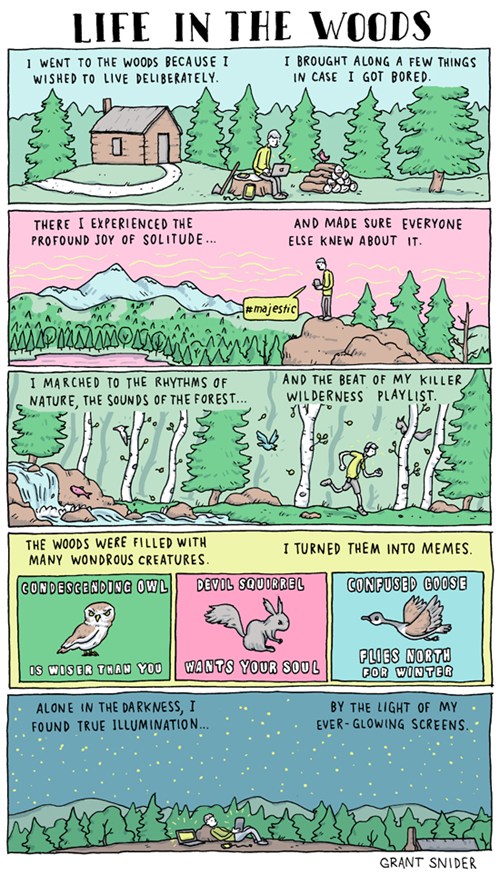
In the summer, I like to go camping at Duck Mountains. One of the reasons I love it there so much? No cell service. I like spending a week in complete peace and quiet. Don't get me wrong, I love my internet. I'd be lost without it. But honestly, when I'm out camping, I don't miss it in the slightest. An evening by the fire with my lovely fiancé, Morgen, beats scrolling through a news feed any day.
Sunday, 25 November 2012
Digital Manners
This past Friday, my fiancé and I went out for supper with my Mom and my little brother. Being the little nerd I am, I found myself thinking about ICT during the meal.
Why? I few minutes after we sat down, another family was seated at the booth behind us. The little girl, maybe 3 or 4, was the cutest little girl you ever did see. And...she was quiet as a mouse throughout the meal apart from her adorably polite ordering (please and thank yous included) and incredibly well behaved chatting with her parents.
Frequently, I read/hear rants about badly behaved children in restaurants. I guess those kids need some tutoring from this little one! In addition to her obvious well-instilled manners, she was partly kept quiet due to the iPod touch in her hand throughout the meal. (I must add the I am often irritated by people having their devices out during a meal - I even wrote a blog post about this earlier. However, this little girl displayed a sense of technology manners often not seen. She wasn't ignoring her parents' questions, she was quick to decide what she wanted to eat, and politely ordered from her waitress. While she waited for her food she played her game, sharing her successes with her mom. When the food arrived, she put the iPod down, thanked the waitress, and ate her food. Honestly one of the most well behaved kids I've seen in a while.
In my ICT class, we have been talking about the concept of ICT literacy throughout the term. One of the aspects of ICT literacy that keeps appearing is the idea of using technology in a responsible way. I think this little girl displayed this. She was not consumed by the technology in her hand, nor did it replace personal contact and communication with her parents and the waitress. She used it as a means to entertain herself (a responsible use of technology) but not to a point where it was hindering a personal connection with others around her.
I think that as technology consumes our world more and more every day, it is important that parents, and we as teachers are concerned about digital responsibility and manners. We need to be teaching this to our children/students so that technology does not over take our society where personal interaction should prevail.
Why? I few minutes after we sat down, another family was seated at the booth behind us. The little girl, maybe 3 or 4, was the cutest little girl you ever did see. And...she was quiet as a mouse throughout the meal apart from her adorably polite ordering (please and thank yous included) and incredibly well behaved chatting with her parents.
Frequently, I read/hear rants about badly behaved children in restaurants. I guess those kids need some tutoring from this little one! In addition to her obvious well-instilled manners, she was partly kept quiet due to the iPod touch in her hand throughout the meal. (I must add the I am often irritated by people having their devices out during a meal - I even wrote a blog post about this earlier. However, this little girl displayed a sense of technology manners often not seen. She wasn't ignoring her parents' questions, she was quick to decide what she wanted to eat, and politely ordered from her waitress. While she waited for her food she played her game, sharing her successes with her mom. When the food arrived, she put the iPod down, thanked the waitress, and ate her food. Honestly one of the most well behaved kids I've seen in a while.
In my ICT class, we have been talking about the concept of ICT literacy throughout the term. One of the aspects of ICT literacy that keeps appearing is the idea of using technology in a responsible way. I think this little girl displayed this. She was not consumed by the technology in her hand, nor did it replace personal contact and communication with her parents and the waitress. She used it as a means to entertain herself (a responsible use of technology) but not to a point where it was hindering a personal connection with others around her.
I think that as technology consumes our world more and more every day, it is important that parents, and we as teachers are concerned about digital responsibility and manners. We need to be teaching this to our children/students so that technology does not over take our society where personal interaction should prevail.
Saturday, 17 November 2012
iBanding
Just a short blog post today.
Earlier this year in my ICT class we looked at some videos of digitally created music (using iPads and iPod Touches).
This video came up on my news feed and I wanted to share it with you all:
Neat, eh? Now, of course this could never replace traditional music making in the band room, but it is certainly a great way to incorporate technology into music. I like this particular video because the music is more authentic. The sounds are not too fake sounding (apart from the little robot man...but everyone loves him!). I think it would be super neat to do an iBand with my classroom sometime in the future (provided that kind of funding/technology is available). This kind of musiking opens up a whole new world of instrumentation and sounds to the students that they would otherwise not experience in the traditional band set-up.
Earlier this year in my ICT class we looked at some videos of digitally created music (using iPads and iPod Touches).
This video came up on my news feed and I wanted to share it with you all:
Neat, eh? Now, of course this could never replace traditional music making in the band room, but it is certainly a great way to incorporate technology into music. I like this particular video because the music is more authentic. The sounds are not too fake sounding (apart from the little robot man...but everyone loves him!). I think it would be super neat to do an iBand with my classroom sometime in the future (provided that kind of funding/technology is available). This kind of musiking opens up a whole new world of instrumentation and sounds to the students that they would otherwise not experience in the traditional band set-up.
Tuesday, 13 November 2012
School Kills Creativity
I just finished a TED talk by Sir Ken Robinson about how "schools kill creativity". Watch it below!
One of Robinson's main points was one which I've discussed before on this blog. This idea being that our education system needs to be preparing students for the future...a future which we have no idea as to what it might look like. He suggests that our current education system is based on a perhaps outdated concept of preparing students for employment in industrialism work-force. However, the face of our work-force and its needs are rapidly changing as our technology advances, meaning that we are no longer preparing students for the careers that are available to them.
The idea from this TED Talk that stuck with me the most is the idea that we squander creativity in students by creating an atmosphere in which students are afraid to be wrong. We teach students to be afraid to be wrong by encouraging the idea that being wrong is the worst thing you can do. In order for creativity to occur ("original ideas with value") one must be prepared to take a chance. If students fear that they might be "incorrect" why would they bother taking this leap into uncertain territory in which they might not be "right".
If we allow our classrooms to be built on a system in which being wrong is a negative thing, we are encouraging habits of thoughts in our students that it is not okay to make mistakes and therefore that it is a bad idea to venture into things we are uncertain about. If the future for which we are preparing our students for is a mystery for us, how can we expect them to be the new creators for our world. If nothing new is being creative, then is there really a new future? Education can no longer function as preparation for the work force. We must be preparing students to be our future...a future which we cannot predict. To do this, the arts (i.e. creativity) must be raised from the bottom of the educational hierarchy and as Robinson suggests, be given the same importance as literacy.
One of Robinson's main points was one which I've discussed before on this blog. This idea being that our education system needs to be preparing students for the future...a future which we have no idea as to what it might look like. He suggests that our current education system is based on a perhaps outdated concept of preparing students for employment in industrialism work-force. However, the face of our work-force and its needs are rapidly changing as our technology advances, meaning that we are no longer preparing students for the careers that are available to them.
The idea from this TED Talk that stuck with me the most is the idea that we squander creativity in students by creating an atmosphere in which students are afraid to be wrong. We teach students to be afraid to be wrong by encouraging the idea that being wrong is the worst thing you can do. In order for creativity to occur ("original ideas with value") one must be prepared to take a chance. If students fear that they might be "incorrect" why would they bother taking this leap into uncertain territory in which they might not be "right".
If we allow our classrooms to be built on a system in which being wrong is a negative thing, we are encouraging habits of thoughts in our students that it is not okay to make mistakes and therefore that it is a bad idea to venture into things we are uncertain about. If the future for which we are preparing our students for is a mystery for us, how can we expect them to be the new creators for our world. If nothing new is being creative, then is there really a new future? Education can no longer function as preparation for the work force. We must be preparing students to be our future...a future which we cannot predict. To do this, the arts (i.e. creativity) must be raised from the bottom of the educational hierarchy and as Robinson suggests, be given the same importance as literacy.
Sunday, 11 November 2012
Twitter Test Drive Continues
As I wrote last week, I am giving Twitter another try. I'm still not sold, but I'm giving it a shot.
As part of the test-drive, I was instructed to follow a particular "list" of people. I found the list easily enough and clicked subscribe. However, apparently that does not mean those people will all show up in your regular newsfeed. Lame. If I want to see updates from that list, I have to add a few more clicks to my Twitter visit to do so. (First-World Problems...I know.) This irritates me.
This problem led me to HootSuite - a website allowing you to create a dashboard of sorts to organize what Twitter has to offer. You can create lists of things - your basic newsfeed, particular hashtags, lists of people, and post in which you've be mentioned. As well, you can import feeds from a variety of other social media sites like Facebook, LinkedIn, Google +, Foursquare, and MySpace (who uses that anymore?).
I like HootSuite because it allows me to see all my Twitter "stuff" all at once, with one click. However, it is unfortunate that I couldn't just do this on Twitter itself instead of creating yet another online account. I can definitely see the value of a service like this though for avid Twitter users who follow a lot of people and are interested to see how their own Tweets are being received/shared with others. All in all, HootSuite is a worthwhile website and does the job well, I just wish it wasn't necessary.
As part of the test-drive, I was instructed to follow a particular "list" of people. I found the list easily enough and clicked subscribe. However, apparently that does not mean those people will all show up in your regular newsfeed. Lame. If I want to see updates from that list, I have to add a few more clicks to my Twitter visit to do so. (First-World Problems...I know.) This irritates me.
This problem led me to HootSuite - a website allowing you to create a dashboard of sorts to organize what Twitter has to offer. You can create lists of things - your basic newsfeed, particular hashtags, lists of people, and post in which you've be mentioned. As well, you can import feeds from a variety of other social media sites like Facebook, LinkedIn, Google +, Foursquare, and MySpace (who uses that anymore?).
I like HootSuite because it allows me to see all my Twitter "stuff" all at once, with one click. However, it is unfortunate that I couldn't just do this on Twitter itself instead of creating yet another online account. I can definitely see the value of a service like this though for avid Twitter users who follow a lot of people and are interested to see how their own Tweets are being received/shared with others. All in all, HootSuite is a worthwhile website and does the job well, I just wish it wasn't necessary.
Sunday, 4 November 2012
Twitter Re-Try
Okay, so after a little push from a professor, I have re-activated my (previously mentioned) Twitter profile. As I mentioned in an earlier blog post, I used to have a Twitter account, but deactivated it because I couldn't seem to find a practical use for it. I just didn't "get" it. However, I am currently involved in a group project about using social media in education, so I am back.
In doing some research for this project, Twitter kept coming up over and over again. Obviously I am missing something if that many people find it useful and meaningful... One website/presentation I looked at (http://www.blogger.com/blogger.g?blogID=856919732755217570#editor/target=post;postID=3924918296399476507) suggested a Twitter-Test-Drive:
Step 1: Follow Dr. Joseph Pisano's list of music educators.....DONE
Step 2: Search the hashtags: #musedchat #musiced #mused #artsed.....DONE
I Have to admit, I've already stumbled on some pretty interesting things...
Here's one of the first neat things I found:
http://www.lessonlogs.com
On this website, you can create an account to keep track of all your students' lessons/lesson notes/practice. You can make a list of all the students in your studio/class and make lesson schedules. During/after lessons, you can make notes for the students. Students have their own account which allows them to see the notes you've made for them. Also (and I think this is the cool part amidst all the talk of practice records in my classes) students are able to track their practice with start/end times, notes about what they practiced, and a self-given rating for the practice session. The website tracks practice stats with graphs. I see this working better for private teachers, but you might be able to make it work in a larger setting too...I'd have to play with it more before I can say for sure. I might have to try this out with a few of my own students...
Perhaps I was too quick to discredit Twitter...
Now I guess I just wait and see what else shows up in my feed over the next few days!
If you're not already on Twitter, I encourage readers to try the Twitter-Test-Drive for themselves and see what they discover. Stay tuned for my findings!
In doing some research for this project, Twitter kept coming up over and over again. Obviously I am missing something if that many people find it useful and meaningful... One website/presentation I looked at (http://www.blogger.com/blogger.g?blogID=856919732755217570#editor/target=post;postID=3924918296399476507) suggested a Twitter-Test-Drive:
Step 1: Follow Dr. Joseph Pisano's list of music educators.....DONE
Step 2: Search the hashtags: #musedchat #musiced #mused #artsed.....DONE
I Have to admit, I've already stumbled on some pretty interesting things...
Here's one of the first neat things I found:
http://www.lessonlogs.com
On this website, you can create an account to keep track of all your students' lessons/lesson notes/practice. You can make a list of all the students in your studio/class and make lesson schedules. During/after lessons, you can make notes for the students. Students have their own account which allows them to see the notes you've made for them. Also (and I think this is the cool part amidst all the talk of practice records in my classes) students are able to track their practice with start/end times, notes about what they practiced, and a self-given rating for the practice session. The website tracks practice stats with graphs. I see this working better for private teachers, but you might be able to make it work in a larger setting too...I'd have to play with it more before I can say for sure. I might have to try this out with a few of my own students...
Perhaps I was too quick to discredit Twitter...
Now I guess I just wait and see what else shows up in my feed over the next few days!
If you're not already on Twitter, I encourage readers to try the Twitter-Test-Drive for themselves and see what they discover. Stay tuned for my findings!
Sunday, 28 October 2012
Death of Face-to-Face; ICT Etiquette
This past Friday, my fiancé decided to go to a movie - Paranormal Activity 4. Going to a movie is not too frequent an activity as it is expensive, nor do we have a lot of time that isn't filled with various classes and assignments as we are both fourth year university students.
After spending our nearly thirty dollars on tickets and snacks, we found our seats. Looking down through the seats, I could see so many lit up screens. This made me think of a poem I wrote last year for a creative writing class:
Amongst all the options we have for communicating with one another: e-mail, instant messaging, text messages, phone, video chats, airplane sky-writing... - I still prefer face-to-face communication with people. Only through being with a person can you truly understand what they are saying. There is so much more to communication than words - voice inflection, body language, touch, facial expression...and only through real time, in person contact can you get all these facets of communication. Of course, I'm not saying that I don't text message or message through Facebook, but I know when it is more appropriate to talk to someone in person.
Sometimes I fear that with all the technological advances we have, the ability of people to clearly communicate with another is actually declining. I think that part of our responsibility as ICT literacy educators is to teach students when different forms of communication is appropriate. Perhaps along with ICT literacy, we should also be teaching students about ICT Etiquette. Digital communication cannot be a replacement for personal, one-on-one contact.
After spending our nearly thirty dollars on tickets and snacks, we found our seats. Looking down through the seats, I could see so many lit up screens. This made me think of a poem I wrote last year for a creative writing class:
Death of Face-to-FaceLooking at all those phones lit up made me think about why one would even bother to be at the movie. If you're out with someone, I think you should be focused on them, not involved in multiple conversations at the same time. When I am with someone in a one-on-one setting and their face is buried in their phone half the time, it makes me feel unimportant, not worth the time of day. If you were on a date with someone, you wouldn't spend half your time speaking to someone at the next table would you?
iPod, iPad, iPhoneiLifeeMail, textDigitized world.Infinitely attached to the world,Hopelessly disconnected.Too busy for our family,Check Facebook 24 times a day.Take one dose per hour, repeat daily.867 “friends”, but not one to call.Hollow social life, like a dollar-store vase.Notifications, news feeds;Feeds like a parasite,Consuming our energy.Wasting our time.#insanity #isthisreallife#whathappenedtorealityCommunication instantly across the world: unremarkable.Communication across the dinner table: non-existent.Phones and computers sewn to our hands,The stitches dig deep, technology controlling us.Puppets at the ends of their cables,Dancing to whatever song they play.Cast away your digital tethers.Meet a friend and look them in the eye.Ignore the buzz, for just a moment.Step back into reality.
Amongst all the options we have for communicating with one another: e-mail, instant messaging, text messages, phone, video chats, airplane sky-writing... - I still prefer face-to-face communication with people. Only through being with a person can you truly understand what they are saying. There is so much more to communication than words - voice inflection, body language, touch, facial expression...and only through real time, in person contact can you get all these facets of communication. Of course, I'm not saying that I don't text message or message through Facebook, but I know when it is more appropriate to talk to someone in person.
Sometimes I fear that with all the technological advances we have, the ability of people to clearly communicate with another is actually declining. I think that part of our responsibility as ICT literacy educators is to teach students when different forms of communication is appropriate. Perhaps along with ICT literacy, we should also be teaching students about ICT Etiquette. Digital communication cannot be a replacement for personal, one-on-one contact.
Sunday, 21 October 2012
What Happened to Human Contact?
Earlier this week, I was looking for "SmartBoard in the band room" ideas with my class partner. I came across the idea of using the board to have students sign in digitally as they enter the classroom in lieu of the teacher doing attendance. Immediately after reading this idea, I hated it.
I love technology, but not when it hinders meaningful personal contact. In several music-education courses, we have been told that the two most important minutes of your class are as the students are coming into your classroom and when they are leaving. The time before class begins should be used to create relationships with your students. How could a teacher be so disconnected that they are not even aware of which students bothered to show up to their class. I word this as "bothered to show up" because that's how a teacher like that would make me feel. If the teacher can't even tell whether I am there or not, why would I be motivated to attend class?
As many of my colleagues have mentioned in their own blog posts, technology needs to be used in a meaningful way. Technology should be a means to enhance education, not hinder it. A personal connection with your students is an incredibly important aspect in a classroom environment...and in no classroom is this more important than in the band room. Musicking is very personal. We expect students to "put themselves out there" and express themselves. In order for students to be comfortable doing this, they need to feel a high level of trust with you and know that you care about them. If any technology takes away from students and teachers being able to create this important relationship, then it has no place in the band room.
I love technology, but not when it hinders meaningful personal contact. In several music-education courses, we have been told that the two most important minutes of your class are as the students are coming into your classroom and when they are leaving. The time before class begins should be used to create relationships with your students. How could a teacher be so disconnected that they are not even aware of which students bothered to show up to their class. I word this as "bothered to show up" because that's how a teacher like that would make me feel. If the teacher can't even tell whether I am there or not, why would I be motivated to attend class?
As many of my colleagues have mentioned in their own blog posts, technology needs to be used in a meaningful way. Technology should be a means to enhance education, not hinder it. A personal connection with your students is an incredibly important aspect in a classroom environment...and in no classroom is this more important than in the band room. Musicking is very personal. We expect students to "put themselves out there" and express themselves. In order for students to be comfortable doing this, they need to feel a high level of trust with you and know that you care about them. If any technology takes away from students and teachers being able to create this important relationship, then it has no place in the band room.
Sunday, 14 October 2012
Twitter in the Classroom
Perhaps this post is a little hypocritical seeing as a previous blog was about using a Twitter-inspired board in the classroom, but bear with me... (My other post talked more about what students could share using a Twitter-like forum, this is more about what a classroom could take in from Twitter.)
I just don't "get" the whole Twitter thing. I avoided it for the longest time, but one day got curious enough to set up my own account. After exploring for a while...I still didn't get it. In fact, just a few days ago, I deleted my account.
In several ICT classes, the idea of using Twitter in the classroom has been mentioned. I even saw it mentioned in a newspaper yesterday - an award winning teacher that incorporates Twitter. With my experience, however, I couldn't really understand how one could use Twitter in the classroom in a meaningful way.
I decided to do a little research. So, I Googled "using twitter in the classroom". The first result: http://www.teachhub.com/50-ways-use-twitter-classroom --> a list of 50 ways to use Twitter in the classroom. I feel as though many of these ideas seem as though they are using Twitter just for the sake of using Twitter.
I like the idea of using Twitter to share information between members of a class (i.e. assignment info/due dates, collaboration on projects, posting of articles/videos relevant to lesson topics) as well as using it as a way to connect classrooms across the hall or across the world. However, I still don't quite understand how students might be expected to gather much information from Twitter beyond basic ideas. To find in depth information, students would need to be directed to other websites anyways. (E.g. students might find news headlines, but that doesn't tell them the full story...students might find quotes...but there is no context)
Maybe I just don't understand Twitter and maybe I didn't give it enough of a chance, but I just don't see how it can be used in a truly meaningful way that won't distract from the point of a lesson. If someone has any good ideas, I would love to hear them. I want to like Twitter, I really do! But right now...I just don't get it.
I just don't "get" the whole Twitter thing. I avoided it for the longest time, but one day got curious enough to set up my own account. After exploring for a while...I still didn't get it. In fact, just a few days ago, I deleted my account.
In several ICT classes, the idea of using Twitter in the classroom has been mentioned. I even saw it mentioned in a newspaper yesterday - an award winning teacher that incorporates Twitter. With my experience, however, I couldn't really understand how one could use Twitter in the classroom in a meaningful way.
I decided to do a little research. So, I Googled "using twitter in the classroom". The first result: http://www.teachhub.com/50-ways-use-twitter-classroom --> a list of 50 ways to use Twitter in the classroom. I feel as though many of these ideas seem as though they are using Twitter just for the sake of using Twitter.
I like the idea of using Twitter to share information between members of a class (i.e. assignment info/due dates, collaboration on projects, posting of articles/videos relevant to lesson topics) as well as using it as a way to connect classrooms across the hall or across the world. However, I still don't quite understand how students might be expected to gather much information from Twitter beyond basic ideas. To find in depth information, students would need to be directed to other websites anyways. (E.g. students might find news headlines, but that doesn't tell them the full story...students might find quotes...but there is no context)
Maybe I just don't understand Twitter and maybe I didn't give it enough of a chance, but I just don't see how it can be used in a truly meaningful way that won't distract from the point of a lesson. If someone has any good ideas, I would love to hear them. I want to like Twitter, I really do! But right now...I just don't get it.
Thursday, 4 October 2012
Digital Footprints
This week in class we've been talking about our digital footprint. We talked about taking control of your digital footprint - keeping it clean, and only allowing people to see what you want them to see.
There was a mention of employers (potential or current) looking at your social media sites to see what kind of person you are outside of the workplace. This has got me thinking about the question of whether or not things found on social media websites are any of an employers business in the first place.
I have been thinking about this question, and still haven't come up with a good answer.
Take for example any one of our Facebook pages. I keep my Facebook page quite clean (partly due to the fact I am not a partier...and therefore there is no opportunity for questionable pictures to be posted) but I know for a fact that many students have pictures of themselves having fun at parties - perhaps with some kind of alcohol in their hand. Maybe another picture shows you "scantily clad" at a beach.
Should this pictures like this give a prospective employer a negative view of you? If you are able to come into work and give 100% consistently, then why should these pictures/statues matter?
Thinking about this problem, it is not possible to ignore the fact that teachers tend to be held at a higher standard than people in other professions. I remember being in high school and seeing a teacher pulled over getting a ticket. That was big news in the school! Is that fair? Are teachers not regular humans? Aren't we allowed to "let our hair down" once in a while? And when we do...should evidence be allowed on Facebook?
Interesting topic, that I definitely haven't come to any conclusions about.
What do you all think?
There was a mention of employers (potential or current) looking at your social media sites to see what kind of person you are outside of the workplace. This has got me thinking about the question of whether or not things found on social media websites are any of an employers business in the first place.
I have been thinking about this question, and still haven't come up with a good answer.
Take for example any one of our Facebook pages. I keep my Facebook page quite clean (partly due to the fact I am not a partier...and therefore there is no opportunity for questionable pictures to be posted) but I know for a fact that many students have pictures of themselves having fun at parties - perhaps with some kind of alcohol in their hand. Maybe another picture shows you "scantily clad" at a beach.
Should this pictures like this give a prospective employer a negative view of you? If you are able to come into work and give 100% consistently, then why should these pictures/statues matter?
Thinking about this problem, it is not possible to ignore the fact that teachers tend to be held at a higher standard than people in other professions. I remember being in high school and seeing a teacher pulled over getting a ticket. That was big news in the school! Is that fair? Are teachers not regular humans? Aren't we allowed to "let our hair down" once in a while? And when we do...should evidence be allowed on Facebook?
Interesting topic, that I definitely haven't come to any conclusions about.
What do you all think?
Thursday, 27 September 2012
"Social Media" in the Classroom
I came across these two images the other day from some creative teachers:
https://blogger.googleusercontent.com/img/b/R29vZ2xl/AVvXsEgD9py_k0aZrt8BCjOntHWJRUR9E8cBfIBKJWD74wEqfwNXx9uwS-SWHLkIk9q4l71EDaJflM5c_Uyt6ahoihlZbh753_Pb9iicmRIAeJqHyJwMAhVfDYGI3vByh7DJWhoYm4eBzQUkxHs/s1600-h/DSC00825
(sorry I seem to have lost the original blog that it came off of...)
AND
http://www.flickr.com/photos/mownbywhite/6479537243/lightbox/
(this is from a 5th grade teacher's blog found at: http://mesmrswhitesclass.blogspot.ca)
I thought this was a unique way of incorporating ICT into the classroom, without...actually using ICT.
An idea like this allows teachers and students to explore social media on a small scale and within a perfectly safe environment. This would be a good first step for teachers/parents who have concerns about their students/children using social media networks like Facebook and Twitter and could show them the value in using such things in the classroom.
https://blogger.googleusercontent.com/img/b/R29vZ2xl/AVvXsEgD9py_k0aZrt8BCjOntHWJRUR9E8cBfIBKJWD74wEqfwNXx9uwS-SWHLkIk9q4l71EDaJflM5c_Uyt6ahoihlZbh753_Pb9iicmRIAeJqHyJwMAhVfDYGI3vByh7DJWhoYm4eBzQUkxHs/s1600-h/DSC00825
(sorry I seem to have lost the original blog that it came off of...)
AND
http://www.flickr.com/photos/mownbywhite/6479537243/lightbox/
(this is from a 5th grade teacher's blog found at: http://mesmrswhitesclass.blogspot.ca)
I thought this was a unique way of incorporating ICT into the classroom, without...actually using ICT.
An idea like this allows teachers and students to explore social media on a small scale and within a perfectly safe environment. This would be a good first step for teachers/parents who have concerns about their students/children using social media networks like Facebook and Twitter and could show them the value in using such things in the classroom.
Additionally, bulletin boards set up like this are simply a unique and relatable way for students to see/share information. The "Facebook Wall" is a good way to summarize the learning that is currently taking place in the classroom, as well as a place to share information about the classroom and students, and post events, important notes, and pictures.
The "Twitter Feed" would be a good place for students to have a place to express themselves. They could "tweet" about things they learned that day, how they're feeling, or what's on their mind. I might use the Twitter feed for students to tweet about their learning that day and use it as an "exit slip". This feed could give the teacher a snapshot of student learning and use it to judge how well a lesson was received that day.
Interesting concept.
What do you think? How might you use something like this in your classroom?
Monday, 24 September 2012
We need you. We believe in you. And we're counting on you.
This post is not so much ICT related but I still thought it was worthwhile to share. I found this video (again on Pinterest...no surprise) a little before the school year started and I've watched it a few times since. It's a man's "open letter to students returning to school".
http://www.youtube.com/watch/?v=x78PnPd-V-A
We tend to think of education in terms of the students and learners. In other words, we advocate for education because the learner benefits from the learning. This video takes a bit of a different spin on things, in a way which I had never really given much thought to. He suggests that education is not necessarily for the benefit of the student, but rather for the benefit of society as a whole. We pay education taxes and support education in other ways because students learning things has the potential to make our lives better.
If we are not educating our students properly and inspiring them to continue learning and discovering, who will be the scientist to put humans on mars? Which doctor will discover the cure for breast cancer? Which composer will be the next Beethoven? Or who will discover a method of making microwave pizza so that it actually has a crispy crust? (Suggestion courtesy of the man in the video.) If we do not inspire our students to be lifelong learners, these things may be impossible.
As I mentioned in my first blog, we are preparing students for the future, not the present. We are not training them for jobs, but rather helping them to become lifelong thinkers and learners so that they may thrive in an environment that we cannot even imagine today. To think of it in terms of this video, we are preparing our students to be beneficial for the future of our society so that we might all have better lives.
Just thought this was an interesting way to think about education in general.
Post your thoughts in the comments.
(P.S. Please note that I don't like to think of education as simply preparation for future employment, but I just like that the video shows a unique view of education that is less thought of.)
http://www.youtube.com/watch/?v=x78PnPd-V-A
We tend to think of education in terms of the students and learners. In other words, we advocate for education because the learner benefits from the learning. This video takes a bit of a different spin on things, in a way which I had never really given much thought to. He suggests that education is not necessarily for the benefit of the student, but rather for the benefit of society as a whole. We pay education taxes and support education in other ways because students learning things has the potential to make our lives better.
If we are not educating our students properly and inspiring them to continue learning and discovering, who will be the scientist to put humans on mars? Which doctor will discover the cure for breast cancer? Which composer will be the next Beethoven? Or who will discover a method of making microwave pizza so that it actually has a crispy crust? (Suggestion courtesy of the man in the video.) If we do not inspire our students to be lifelong learners, these things may be impossible.
As I mentioned in my first blog, we are preparing students for the future, not the present. We are not training them for jobs, but rather helping them to become lifelong thinkers and learners so that they may thrive in an environment that we cannot even imagine today. To think of it in terms of this video, we are preparing our students to be beneficial for the future of our society so that we might all have better lives.
Just thought this was an interesting way to think about education in general.
Post your thoughts in the comments.
(P.S. Please note that I don't like to think of education as simply preparation for future employment, but I just like that the video shows a unique view of education that is less thought of.)
Thursday, 20 September 2012
Tagxedo.com
I ran into this website, tagxedo.com, a while back on Pinterest, but never actually opened it up to see what it was all about. I decided that now would be a perfect time to check it out for a new blog post.
I think I am a fan. Basically, it is like Wordle, but you have more control. The best part is that you can choose a shape for the words to form into. You can use one of the various ones included on the website or you can upload your own picture apparently (haven't quite worked that out yet...) As with Wordle, you still have control over colour scheme, the orientation of the words, and the font.
I find that this program is a little more complicated to use than Wordle, but if you can figure it out, then its worth it. In addition to the ability to control the shape of the words, you are also able to save your image in various formats (jpg, png, imgur), create a URL to share on a website, or print. There are some advanced saving settings for users more comfortable with technology. It is a little more visually stimulating as well if images are shared directly from the Tagxedo website because the words will pop out as you move your cursor over them. (This feature works when I click on the following link, so I hope it works for you as well.)
Let's see if this work. This is a link to one of the pictures I made -->
http://www.tagxedo.com/artful/3ad12bac019a45aa
Here is an image of another:

I think I am a fan. Basically, it is like Wordle, but you have more control. The best part is that you can choose a shape for the words to form into. You can use one of the various ones included on the website or you can upload your own picture apparently (haven't quite worked that out yet...) As with Wordle, you still have control over colour scheme, the orientation of the words, and the font.
I find that this program is a little more complicated to use than Wordle, but if you can figure it out, then its worth it. In addition to the ability to control the shape of the words, you are also able to save your image in various formats (jpg, png, imgur), create a URL to share on a website, or print. There are some advanced saving settings for users more comfortable with technology. It is a little more visually stimulating as well if images are shared directly from the Tagxedo website because the words will pop out as you move your cursor over them. (This feature works when I click on the following link, so I hope it works for you as well.)
Let's see if this work. This is a link to one of the pictures I made -->
http://www.tagxedo.com/artful/3ad12bac019a45aa
Here is an image of another:
I think in some ways this website would be more useful than Wordle, and in some ways less useful. It is nicer in that you have more control over your creation as well as greater ability to save/share it. However, the user interface is quite a bit more complicated and hard to understand.
One idea I thought about using this for would be to have students upload an image of themselves and then fill it with words to represent them. These could be posted around the room to show what each individual is bringing to the group. As well, it could be used in a similar way as I have done - to have students brainstorm what music/band (or whatever other subject area) means/what it involves.
If anyone else does some playing around with this program and finds some useful features that I missed (or figures out how to make uploading pictures work) please let me know in the comments!
Friday, 14 September 2012
First blog...ever.
I have never written a blog before, but here goes...
I tend not to be a very "public" person, so blogging is something quite outside my comfort zone. However, I am willing to try it out. Who knows? Maybe I will like it!
This week in ICT class we were introduced to the idea of integrating technology into our classrooms. So, the following is a collection of my thoughts about ICT and how it relates to education:
The technology available to this generation of students is incredible! Think about the difference between our education experience to that of our parents. How did they manage without Google? Wikipedia? YouTube? These things have become ingrained into our lives and it is hard to imagine our lives before them.
With the rapid advances in technology every day it won't be long until the way we learned/the way we live will seem outdated. Because of this, it is incredibly important that we, as teachers, do not fall behind on the changes in the ICT world. There are so many incredible tools available to us (think Internet, iPads, SmartBoards) and it would be a shame for them to go to waste in our classrooms, never using them to their full capabilities. It would be such a disadvantage to our students for them to be missing out on these opportunities to learn in new and innovative ways.
Band and music classrooms hold many opportunities to integrate ICT into learning. Students can record their own playing, write their own music, and even create digital music. Then, they can upload their work to the internet and share them with the entire world. And...all this can be done with their fingertips on an iPad.
I am excited to learn through this ICT class various ways that I can integrate technology into my own classroom in a meaningful way that truly helps students learn more effectively.
I tend not to be a very "public" person, so blogging is something quite outside my comfort zone. However, I am willing to try it out. Who knows? Maybe I will like it!
This week in ICT class we were introduced to the idea of integrating technology into our classrooms. So, the following is a collection of my thoughts about ICT and how it relates to education:
The technology available to this generation of students is incredible! Think about the difference between our education experience to that of our parents. How did they manage without Google? Wikipedia? YouTube? These things have become ingrained into our lives and it is hard to imagine our lives before them.
With the rapid advances in technology every day it won't be long until the way we learned/the way we live will seem outdated. Because of this, it is incredibly important that we, as teachers, do not fall behind on the changes in the ICT world. There are so many incredible tools available to us (think Internet, iPads, SmartBoards) and it would be a shame for them to go to waste in our classrooms, never using them to their full capabilities. It would be such a disadvantage to our students for them to be missing out on these opportunities to learn in new and innovative ways.
Band and music classrooms hold many opportunities to integrate ICT into learning. Students can record their own playing, write their own music, and even create digital music. Then, they can upload their work to the internet and share them with the entire world. And...all this can be done with their fingertips on an iPad.
I am excited to learn through this ICT class various ways that I can integrate technology into my own classroom in a meaningful way that truly helps students learn more effectively.
Subscribe to:
Posts (Atom)